
FASCR®, which stands for Framework Agnostic Security, Compliance, and Resilience, is the operational model that defines how the Cyturus CRT enables organizations to manage security, compliance, and resilience through a single, unified control set.
FASCR® enables organizations to operate from one control system, support multiple regulatory frameworks, align security activities with risk and business objectives, and continuously measure and improve control maturity.
Why FASCR Exists
Traditional compliance approaches are framework-centric. Organizations typically operate separate programs for each framework, such as CMMC, ISO 27001, HIPAA, and PCI, even when those frameworks share many of the same underlying security requirements. The result is duplicated controls, redundant work, inconsistent evidence, repeated assessments, and fragmented visibility across the program.
FASCR® replaces this model with a control-centric approach. Instead of managing frameworks independently, organizations operate from a single control set, the Living Control Set™, and evaluate it against multiple frameworks through Conformity Engagements.
💡Think of it this way: rather than building a separate program for each framework, you build one program and check it against as many frameworks as you need.
How FASCR® Works in the CRT
FASCR® operates through five connected layers, each building on the one before it.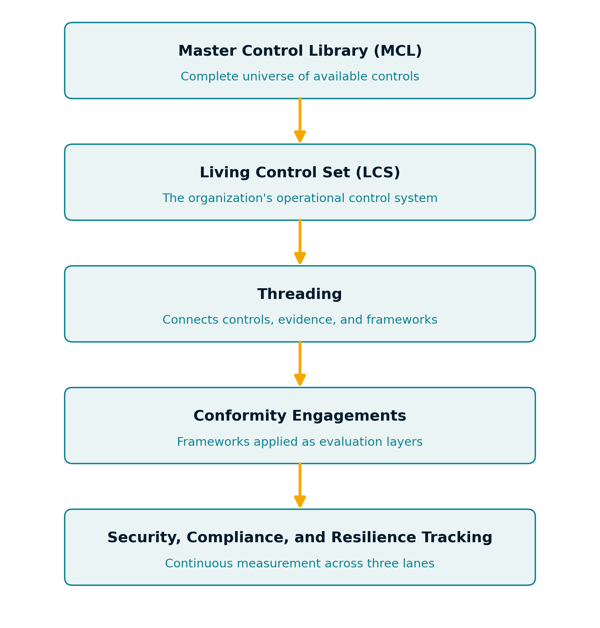
1. Master Control Library (MCL)
The complete universe of controls available in the CRT. The Secure Controls Framework (SCF) serves as the MCL, providing a normalized control structure drawn from over 250 global regulatory and industry frameworks.
2. Living Control Set (LCS)
The organization-specific subset of controls from the Master Control Library that represents the controls the organization actually governs and operates. The LCS provides real-time situational awareness of the organization's control posture.
3. Threading
Threading is the mechanism that connects controls, assessment objectives, evidence, frameworks, and risks. When you implement a control or collect evidence for it, that work automatically applies everywhere the control appears across your program. Threading ensures that a single action can satisfy multiple framework requirements at the same time, that updates to a control are reflected across all related frameworks, and that reporting stays consistent no matter which compliance view you're looking at.
4. Conformity Engagements
Frameworks are applied as evaluation layers on top of the LCS rather than as separate programs. A Conformity Engagement allows the organization to rapidly evaluate a new compliance requirement or manage a specific scope without duplicating the underlying control work.
5. Security, Compliance & Resilience Tracking
The CRT tracks how effectively controls are implemented and operated over time across three lanes:
-
Compliance measures how the organization meets assessment objectives to prepare for internal or external audits and assessments.
-
Maturity measures how well security and governance practices are established and consistently followed, from ad hoc processes to fully documented, repeatable ones that the organization actively monitors and improves.
-
Resilience reflects the organization's ability to sustain secure operations, withstand disruption, and maintain control effectiveness under real-world conditions.
Key Principles
FASCR® is built on four principles that distinguish it from traditional compliance approaches.
-
Controls are the system. Security, compliance, and resilience are managed through actions, not frameworks.
-
Frameworks are views. Frameworks are applied as lenses to evaluate the same system of controls, not as separate programs.
-
One action, multiple outcomes. A single control, when implemented appropriately, can satisfy multiple framework requirements simultaneously.
-
Continuous evolution. The control system evolves as risks and obligations change and as maturity and resilience improve.
FASCR® and Risk Management
FASCR® integrates security operations with risk management. Control deficiencies are linked to predefined threat scenarios and risk exposure, allowing organizations to prioritize remediation based on real-world impact rather than only compliance gaps. This shifts the focus from checking boxes to managing the controls that actually reduce organizational risk.
Why FASCR® Matters
By operating from a single control set, organizations can reduce duplication across frameworks, improve consistency in how controls are managed and reported, align compliance activities with real organizational risk, and focus on operational effectiveness rather than checklist completion.
The end result is that compliance becomes something the organization does continuously through its day-to-day security operations, rather than something it scrambles to prove during periodic audits.